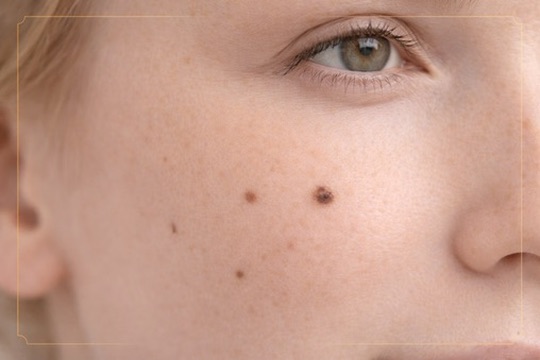
What is the ABCDE rule?
Developed to help people systematically evaluate skin spots, the ABCDE rule breaks down the key visual characteristics that dermatologists look for when assessing a mole. It's a descriptive tool, not a diagnostic one — and it's most useful when used consistently over time to detect change.
A — Asymmetry
Imagine drawing a line through the middle of the spot. In a symmetrical mole, both halves should look roughly the same. If one half looks noticeably different from the other — in shape, colour, or size — that asymmetry is worth noting.
Most ordinary moles are symmetrical or close to it.
B — Border
Look at the edges of the spot. Are they smooth and well-defined? Or are they irregular, ragged, notched, or blurred where the spot seems to fade into surrounding skin?
A clear, even border is generally a reassuring sign. Borders that are hard to define or that look uneven deserve attention.
C — Colour
A single, uniform shade of brown is typical for common moles. Multiple colours within one spot — tan, dark brown, black, red, white, or blue — are worth documenting.
Note any changes in colour over time, including areas that become lighter or darker.
D — Diameter
The traditional guideline uses 6mm (roughly the diameter of a pencil eraser) as a reference point — spots larger than this have historically been flagged for review. However, diameter alone is not definitive: many ordinary moles exceed 6mm, and small spots can also warrant attention.
More useful than size alone is whether the spot is growing.
E — Evolution
This is arguably the most important letter. A mole that is changing — in size, shape, colour, or texture — over weeks or months is the key signal to act on. Most stable moles that have looked the same for years are of low concern.
This is why regular photography is so valuable. Your eye is poor at detecting gradual change; a photo from three months ago is not.
Take a photo of each spot you're monitoring every 4–6 weeks, under the same lighting conditions and distance. Consistent documentation is far more useful than a single assessment.
What to do with your findings
The ABCDE rule is an educational self-monitoring tool — not a diagnosis. If you notice any of the following, book an appointment with a dermatologist:
- A spot that is changing in any of the ABCDE characteristics
- A new spot that looks different from your other moles
- Any spot that bleeds, itches, or crusts without injury
- Anything that simply doesn't feel right to you
When in doubt, get it checked. Dermatologists would always rather see a spot that turns out to be benign than miss one that needed attention.
Building a monitoring habit
The hardest part of mole monitoring is doing it consistently. A simple approach:
- Do a full skin check once a month — use a mirror or ask a partner for hard-to-see areas
- Photograph any spots you're watching
- Keep a visual record so you can compare over time
- Note any new spots that appear